
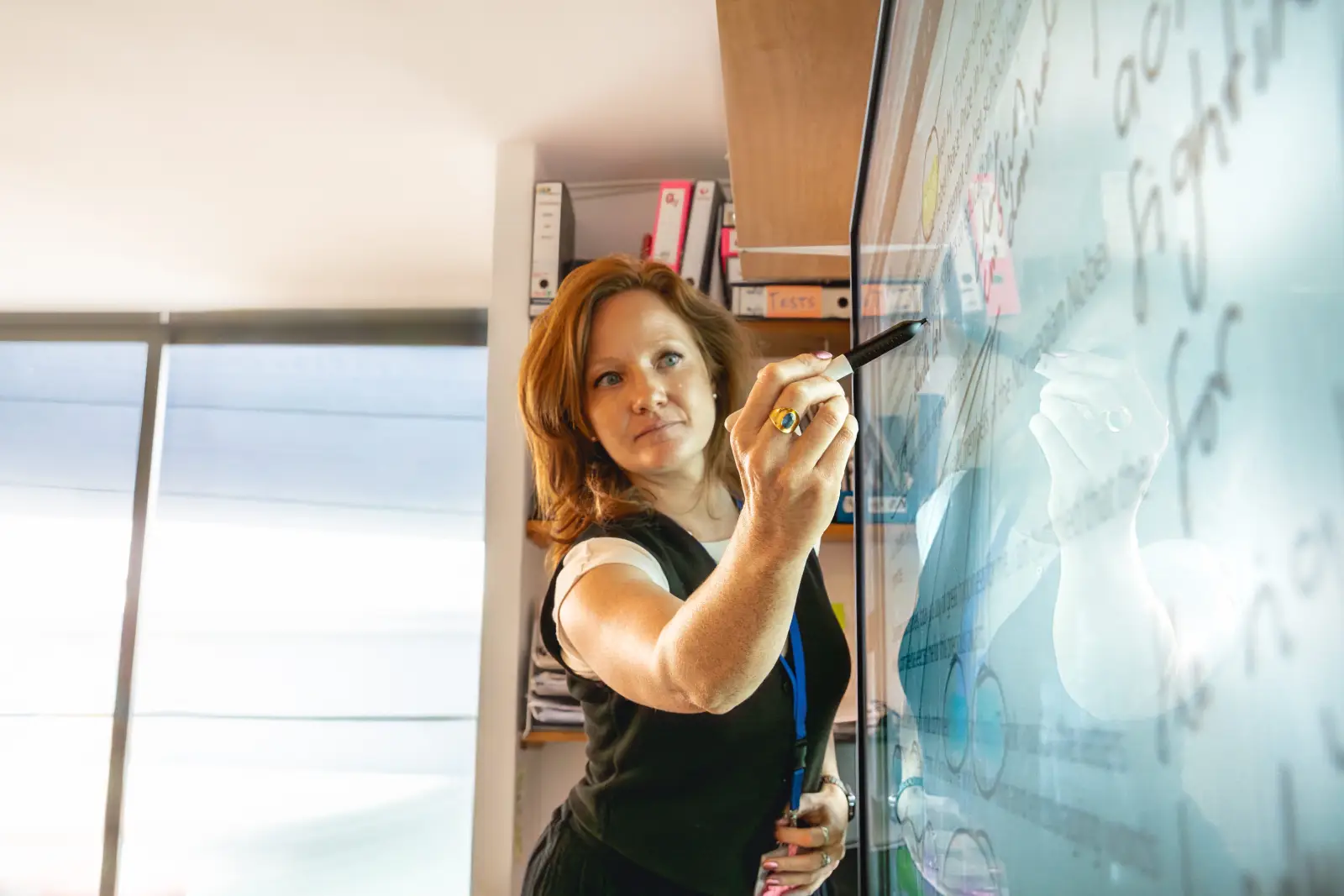
Wingate Secondary School is home to over 250 students from more than 28 nationalities. We follow the UK National Curriculum, supplemented by Spanish lessons. Our Senior School maintains a traditional atmosphere, featuring Prefects selected from Year 11 and a strict uniform policy. Subjects such as Science, Maths, English, and Spanish, we organise smaller groups to enhance individual learning.
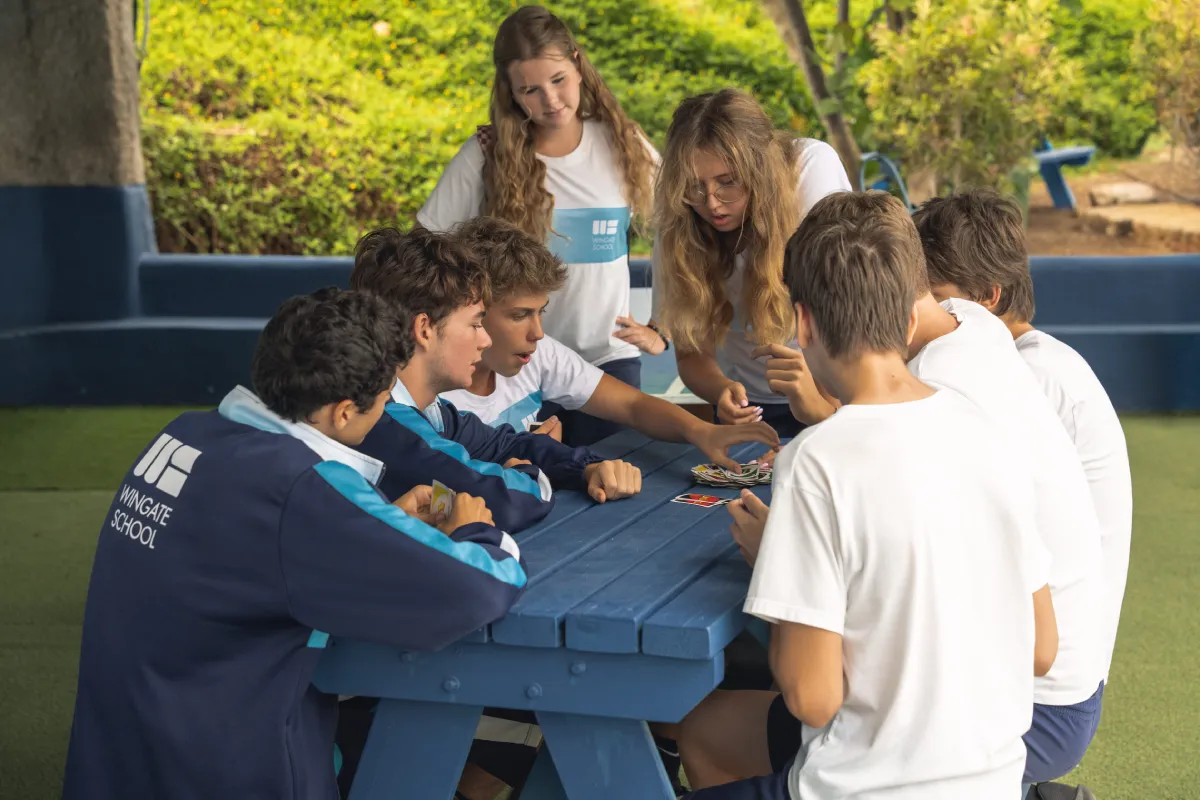
For many families, relocating to Tenerife and enrolling their children in a British school represents a significant transition. Our website’s Policies section offers extensive advice and guidance for families, including details on the ‘British Schools Academic Pathway.’ Additionally, our ‘English as an Additional Language’ policy provides information on the extra support available for students learning English as a second language. Every student participates in an entry interview with the Head of School to ensure that Wingate is the right fit for their learning needs.
At Wingate School, we utilise Google Classroom, and each student is required to have a Chromebook. This educational system provides students and parents with access to a wide array of teaching resources, enabling students to reinforce their learning at home.
We closely monitor student progress through three reports and two parent-teacher afternoons each year, during which parents can meet with their child’s tutor and subject teachers. To foster a strong school-parent relationship, parents can request a meeting at any time by scheduling an appointment through the Office. Effective home-school communication is vital to supporting your child’s academic success.
In Years 7, 8, and 9, all students study Spanish Social Science, which is taught in English. In line with Spanish educational requirements, Spanish national students must study Spanish Social Science in Spanish during Years 10 and 11. This arrangement enables students to validate their British qualifications and facilitates access to Spanish educational pathways, which is also available to our top-set Spanish students.
Curriculum overview
The essence of the Wingate Education
“The journey your child will take as a senior will be one that is supported by many as they work towards their personal best, seeking a learning pathway that resonates with them, and ultimately reaching their personal level of success upon graduation. All students will be assigned to a pastoral tutor who will support individuals through regular one-to-one meetings; creating clear communication pathways with subject teachers, senior management, and parents. Tutors are also on hand to support our students in developing ‘Personalised Learning’ across the school as we build more ways for them to take ownership of their education; develop their confidence and maximise personal learning outcomes.”

Year 7 – 9 Key Stage 3
The overarching aim for students studying English at Wingate School is to promote high standards of language and literacy by equipping pupils with a strong command of the spoken and written word, and to develop their love of literature through widespread reading for enjoyment.
Wingate School follows the UK National Curriculum for English which aims to ensure that all pupils have the ability to read and write easily, fluently, and with a good understanding as well as encouraging and developing the habit of reading widely for pleasure. To achieve this, we have clear Schemes of Work with diverse teaching resources covering a plethora of genres from pre-20th Century text, poetry, play scripts, and modern pros. To ensure that students are actively learning, students are taught using a varied pedagogy: drama, presentations, group media projects as well as building the skills to peer and self-assess work. Progress is tracked through continual and formative assessment with clear personal targets set.
The programme of study for Mathematics at key stage 3 is organised into units that build and develop from key stage 2. Students should make connections across mathematical ideas to develop fluency, mathematical reasoning, and competence in solving increasingly sophisticated problems.
Students are taught to apply their mathematical knowledge in science, geography, computing, and other subjects. Wingate School streams our students dependent on their ability. Decisions about progression are based on the security of pupils’ understanding and their readiness to progress to the next stage. Pupils who grasp concepts rapidly are challenged by being offered rich and sophisticated problems before any acceleration through new content in preparation for key stage 4. Those who are not sufficiently fluent are supported to consolidate their understanding, including through additional practice, before moving on. The Wingate Curriculum and Schemes of Work are streamlined with the UK national curriculum for mathematics and aim to ensure that all pupils:
- become fluent in the fundamentals of mathematics, so that pupils develop conceptual understanding and the ability to recall and apply knowledge rapidly and accurately
- reason mathematically by following a line of enquiry, developing an argument, justification or proof using mathematical language
- can solve problems by applying their mathematics to a variety of routine and non-routine problems with increasing sophistication, including breaking down problems into a series of simpler steps and persevering in seeking solutions.
Wingate students follow the UK National Curriculum where our aim is that all students are able to describe scientific processes and key characteristics in a common language. Students will also be familiar with, and use technical terminology. Wingate students will build up an extended specialist vocabulary to be used in scientific experiments and reports.
The principal focus of science teaching in key stage 3 is to develop a deeper understanding of a range of scientific ideas in the subject disciplines of Biology, Chemistry, and Physics. KS3 Science is taught using a cohesive and inclusive Scheme of Work where each class is taught by a subject specialist: Biology, Physics, Chemistry. Teachers use a varied pedagogy to ensure active learning within their lessons including practical experiments, group projects, and independent study. Progress is monitored through continual assessment to ensure students develop a secure understanding of each key block of knowledge and concepts in order to progress to the next stage.
Wingate students will be taught to develop their creativity and ideas, and increase proficiency in their execution. They will develop a critical understanding of artists, architects, and designers, expressing reasoned judgments that can inform their own work. Pupils will use a range of techniques to record their observations in sketchbooks, journals, and other media as a basis for exploring their ideas.
Students are encouraged to use a range of techniques and media, including painting to increase their proficiency in the handling of different materials. Students will enhance their ability to analyse and evaluate their own work, and that of others, in order to strengthen the visual impact or applications of their work as well as learn about the history of art, craft, design, and architecture, including periods, styles and major movements from ancient times up to the present day.
Wingate’s budding computer programmers are taught to use technology safely, respectfully, responsibly and securely, including protecting their online identity and privacy. Students should be able to recognise inappropriate content, contact, and conduct and know how to report concerns.
Pupils will be taught to design, use and evaluate computer programs whilst building on their understanding of key algorithms that reflect computational thinking as well as using logical reasoning to compare alternative algorithms for the same problem. Our young programmers will learn to use two or more programming languages, at least one of which is textual, to solve a variety of computational problems. Students will continue to develop their understanding of how numbers can be represented in binary, and be able to carry out simple operations on binary numbers. Through projects, group work, and active learning, students will understand the hardware and software components that make up computer systems, and how they communicate with one another and with other systems whilst understanding how instructions are stored and executed within a computer system. Students will progress and develop their understanding of how data of various types (including text, sounds, and pictures) can be represented and manipulated digitally, in the form of binary digits; undertaking creative projects that involve selecting, using, and combining multiple applications across a range of devices. All students are expected to set and achieve challenging goals.
Wingate Geographers follow the UK National Curriculum for Geography where pupils develop contextual knowledge of the location of globally significant places – both terrestrial and marine. Students will develop their ability to define physical and human characteristics and how these provide a geographical context for understanding the links that give rise to key physical and human geographical features of the world.
Students follow a clear Scheme of Work that includes a varied pedagogy to ensure we maximise active learning. Our Geographers will gain confidence in how to collect, analyse and communicate with a range of data gathered through experiences of fieldwork that deepen their understanding of geographical processes. Students will learn how to interpret a range of sources of geographical information, including maps, diagrams, globes, aerial photographs, and Geographical Information Systems (GIS) as well as building on their skill to communicate geographical information in a variety of ways, including through maps, numerical and quantitative skills and writing at length.
Wingate Historians follow the UK National Curriculum for history which aims to ensure that all pupils know and understand the history of Britain as a coherent, chronological narrative, from the earliest times to the present day. Students will learn how people’s lives have shaped this nation and how Britain has influenced and been influenced by the wider world.
Young historians will know and understand significant aspects of the history of the wider world such as the nature of ancient civilizations; the expansion and dissolution of empires; characteristic features of past non-European societies; achievements and follies of mankind to gain and deploy a historically grounded understanding of abstract terms such as ‘empire’, ‘civilization’, ‘parliament’ and ‘peasantry’. Students will build on their understanding of historical concepts such as continuity and change, cause and consequence, similarity, difference, and significance, and use them to make connections, draw contrasts, analyse trends, frame historically-valid questions, and create their own structured accounts, including written narratives, group projects, and presentations as well as themed based active learning days. Wingate historians will gain historical perspective by placing their growing knowledge into different contexts, understanding the connections between local, regional, national, and international history; between cultural, economic, military, political, religious, and social history; and between short- and long-term timescales.
Our Wingate linguists are streamed into sets according to their capabilities. All students will build on the foundations of language learning laid at key stage 2, whether pupils continue with the same language or take up a new one. Students will focus on developing the breadth and depth of their competence in listening, speaking, reading, and writing, based on a sound foundation of core grammar and vocabulary.
French and Spanish as a Foreign Language should enable pupils to understand and communicate personal and factual information that goes beyond their immediate needs and interests, developing and justifying points of view in speech and writing, with increased spontaneity, independence, and accuracy. It should provide suitable preparation for further study.
Native Spanish Speakers follow the Spanish National Curriculum with a clear focus on reading, writing, active listening, and speaking. Students will understand the importance of grammatical structures and patterns, extended vocabulary, and have access to a variety of text covering different genres; poetry, play scripts, news articles, and more informal blogs and diaries.
Students will understand the importance of how the structure of text creates different voices and moods and will develop and use a wide-ranging and deepening vocabulary. Our modern language department has an in-depth scheme of work that covers a multitude of pedagogy to incorporate different learning styles. Individual student’s attainment is tracked through regular formative and informative assessments with clear personal targets reviewed and set to ensure progression. Lessons are planned and delivered to stimulate ideas, develop creative expression, and expand understanding of the language and culture of Spain.
In line with the Spanish system, all Wingate students study Social Science at KS3 where they learn the History and Geography of Spain. Students are taught using a variety of resources and styles including media, presentations, speeches, debates as well as formative and summative assessments. Students develop their minds and learning techniques in readiness for the more in-depth course at KS4.
Our Wingate performers and musicians follow the UK National Curriculum where pupils build on their previous knowledge and skills through performing, composing, and listening. Students will develop their vocal and instrumental fluency, accuracy, and expressiveness. Students will experience and understand musical structures, styles, genres, and traditions, identifying the expressive use of musical dimensions.
Performers are encouraged to use new technologies appropriately; showing appreciation and understanding of a wide range of musical contexts and styles. Wingate students will be encouraged to play and perform confidently in a range of solo and ensemble contexts using their voice, playing instruments musically, fluently and with accuracy and expression both rehearsed and improvised. To stretch our budding performers, students are encouraged to compose unique scores of music and develop musical ideas by drawing on a range of musical structures, styles, genres, and traditions to show increasing sophistication, including the use of tonalities, different types of scales, and other musical devices. We support and nurture our students to listen with increasing discrimination to a wide range of music from great composers and musicians; developing a deepening understanding of the music that they perform and to which they listen.
All students have access to a Personal Tutor who delivers the PSHE course. Wingate students follow a clear scheme of work that covers all areas of their lives in and out of the classroom. PSHE is a vital support to all our students where they are given the life skills they need. Students will cover a wide range of topics including study techniques, mental wellbeing, healthy lifestyles, sex education, and online safety as well as researching career and academic pathways for their future.
Wingate School believes that every child has the capacity to learn, engage, reflect and experience quality Religious Education. RE is taught within a creative, thought-provoking and understanding environment. We discuss the different cultures, religions, and traditions within our diverse communities that are local, national, and worldwide.
Students will develop the skills to be respectful, reflective, intuitive, and open-minded. This is with the vision of making their futures and their world a secure, accepting, and diverse place to live.
Year 10 – 11 Key Stage 4
All students take Edexcel International GCSE English Language A. Assessment is 100% examination and will be graded using the 9 to 1 grading system. You will prepare for two papers: Paper 1, ‘Non-fiction Texts and Transactional Writing’ (2 hours and 15 minutes), worth worth 60% of the total mark, and Paper 2, ‘Poetry and Prose Texts and Imaginative Writing’ (1 hour 30 minutes), worth 40% of the total mark.
Paper 1 consists of an anthology of engaging, contemporary non-fiction texts. You will develop your skills of interpretation and analysis, enabling you to respond to an anthology text in the examination, as well as comparing it with an unseen non-fiction text. You will apply what you have learned about different text types to develop your transactional writing, practising a range of non-fiction writing techniques, planning and proofreading skills.
For Paper 2, you will study and analyse a range of engaging fictional poetry and prose texts from the anthology in preparation for responding to one of the set texts in the examination.
You will learn to apply what you have learned about the writer’s craft in your reading of fiction to inspire and influence your own imaginative writing and develop a range of creative writing techniques, planning and proofreading skills. Resources for preparing and practising for each section of the exam, including videos, additional notes, study guides, past papers and exemplar responses, are all available in the Google Classrooms to help you to study, learn, revise and prepare for your qualification both in class and independently.
All students have the opportunity to prepare for the Edexcel International GCSE English Literature examination, which will be graded using the 9 to 1 grading system. You will learn to read, critically analyse and respond to literary texts in depth (prose, poetry and drama).
During Yrs’ 10 and 11, you will plan, prepare and write coursework essays on ‘An Inspector Calls’ for Modern Drama, and ‘Romeo and Juliet’ for Literary Heritage. Coursework is worth 40% of the total examination grade and is completed with teacher support and supervision.
You will then sit one exam of 2 hours in Yr 11, worth 60% of the total mark. You will write three essays: an analysis of an unseen poem; a comparison of two poems from a prepared poetry anthology; and a critical analysis of a theme or character(s) from ‘Of Mice and Men’. A wide range of resources for support with writing coursework and for all sections of the examination, including videos, study guides, linked websites, past papers, mark schemes and exemplar responses, are all available in the Google Classrooms, allowing you to study, learn, revise and prepare for your qualification in ways that suits you.
Further details on any of the English subjects are available from Mrs Finnie
Students will continue to learn Maths in the same way as in Year 9. Use of a calculator is encouraged throughout the course and students are expected to bring one to every lesson, as well as their normal mathematical equipment (compass, protractor, ruler etc).
Everyone will study number and number systems, sets, algebra, sequences, graphs, geometry, measurement, transformations, statistics and probability. More able students will also study standard form, functions, calculus and vectors.
The course is delivered at two levels, Higher and Foundation. All students sit two x 2 hour papers. Calculators may be used on both papers.
Students will sit exams at the end of the course and be awarded a level 9 – 1. Students aiming to study for an “A” level will be expected to achieve level 6.
Further details are available from Mr Finnie.
Here at Wingate we feel it is very important that a Science subject is included in a young person’s broad base of education. Students have the opportunity to continue to study individual Sciences (see Blocks A & B below) but almost all students will follow the IGCSE Biology Edexcel syllabus. The Science department offers the Entry Level Certificate for Science which is only available to a small number of students and is explained below.
Biology is an interesting and inspiring course suitable for those wanting a final IGCSE qualification and those who require a sound basis for further study. The course includes aspects of modern Biology appropriate for the 21st Century.
Students will learn about:
- The nature and variety of living things
- Structures and functions in living organisms
- Reproduction and inheritance
- Ecology and the Environment
- The use of Biological resources
There are two papers, one of 2 hours and a second of 1 hour 15 minutes. Experimental work is carried out during the two year Biology course, but the final exams are theory papers. Students will sit exams at the end of the course and be awarded a level 9 – 1. Students aiming to study for an ‘A’ level will be expected to achieve level 6. Further details can be obtained from Miss Crane.
The Entry Level Certificate in Science has been designed by Edexcel to provide a progression route for lower attainers. It is an option we use at Wingate for pupils whom we believe will not pass the IGCSE Biology. It helps build confidence and engagement with Science and allows pupils to leave with a Science qualification.
The course consists of a total of six modules; two each for Biology, Chemistry and Physics.
Pupils are taught each module separately and then sit an exam when the teacher feels they are ready; this can be at any point in the year. Pupils may repeat the same exam to improve on their grade.
The year group will be divided between: Advanced, Intermediate and Beginners. In the Advanced set, Spanish is taught as a first language where all students will sit the Edexcel Spanish GCSE at the end of Year 10. Advanced students will then continue their Spanish course in Year 11 preparing for the GCE A level; covering both Spanish Language and Literature. First language Spanish students will also sit the internal First Language exam needed to pass Homologación.
Students in the Intermediate and Beginners classes will sit their Spanish IGCSE at the end of Year 11. All students will have the opportunity to develop their skills in four areas: listening, speaking, reading and writing. They will be able to understand and use the language in formal and informal situations. Reading books and oral presentations will be part of the course. They will learn more about grammar and literature. Students will also gain insight into the culture and civilization of the countries where Spanish is spoken.
This subject is non examinable but compulsory for all students. It is designed to help students develop as individuals. It covers personal development, careers education, health and wellbeing, study skills, skills for independent living, target setting and ‘Education for Employability’.
The school has invested in ‘Unifrog’ software which helps guide students in careers and pathways to Higher Education. The flexible nature of the subject allows content to be negotiated to suit individual and group needs and respond to current affairs and social trends. Students will be encouraged to take part in discussions and learn how to express their point of view within a safe environment. The subject is taught as suggested by the UK National Curriculum guidelines.
Sport and physical activity are considered important at Wingate and are timetabled each week where students will develop their performance in various sports including football, rounders, athletics and netball amongst others. IGCSE PE is a separate optional subject for those who would like a formal qualification in “Physical Education”.
IGCSE Results 2026
| Subject | Nº of Students | Overall Pass Rates | Percentage Grades 4-9 (A*-C) |
Percentage Grades 7-9 (A*-A) |
|---|---|---|---|---|
| Maths | 46 | 100% | 71% | 39% |
| English Language | 31 | 100% | 96% | 16% |
| English Literature | 42 | 100% | 100% | 54% |
| Spanish | 47 | 100% | 97% | 87% |
| Biology | 41 | 100% | 92% | 53% |
| Chemistry | 19 | 100% | 94% | 68% |
| Physics | 20 | 100% | 90% | 55% |
| Business | 14 | 100% | 100% | 28% |
| History | 7 | 100% | 100% | 57% |
| Psychology | 11 | 100% | 73% | 9% |
| Geography | 7 | 100% | 100% | 28% |
| Art & Design | 10 | 100% | 100% | 67% |
| Russian | 3 | 100% | 100% | 100% |
| French | 5 | 100% | 100% | 20% |
| PE | 10 | 100% | 80% | 20% |
| ICT | 22 | 100% | 100% | 30% |
| Perf Arts | 7 | 100% | 100% | 57% |
| TOTAL: | 311 | 100% | 93% | 49% |
Grading structure explained
| New Grading Structure | Previous Grading Structure |
|---|---|
| 9 | A* |
| 8 | A* |
| 7 | B |
| 6 | C |
| 5 | C |
| 4 | C |
| 3 | D |
| 2 | F |
| 1 | G |
| U | U |
Additional info
Useful information for parents
Information Regarding “Homologación”
Homologación is the recognition by the Spanish authorities that a benchmarked level of Secondary education, Spanish language and Spanish studies has been achieved. The importance of Homologación, the requirements and process will be explained to all students.
Homologación is equivalent to:
- Year 11 = 4º ESO (Educación Secundaria Obligatoria)
- Year 13 = Bachillerato
What you need to qualify for Homologación at the end of Year 11:
- 4 (I)GCSEs with grade C, 4 or higher (this can include Spanish IGCSE)
- You must pass the Spanish* and Social Science internal examinations, which are based on the Spanish curriculum. The Spanish curriculum is only taught in Set 1 Spanish. These examinations are inspected and validated by the Spanish authorities.
* The Spanish result at IGCSE does not guarantee you a pass in the Spanish curriculum examinations.Homologacion is required at the end of Year 11 if students wish to continue onto Spanish vocational qualifications or Bachillerato.
What you need to qualify for Homologación at the end of Year 13:
- The Homologación certificate from Year 11
- 5 GCSEs with grade C, level 4 or higher
- 2 A levels* at grade E or higher or 2 AS and 1 A level with grade E or higher
* Spanish is not a compulsory subject and there are no Social Science studies in the Sixth Form Homologación is required at the end of Year 13 if students wish to continue onto Spanish vocational qualifications at higher level. It could be also required for entry into a Spanish University in some cases.
What is “Social Science”?
Social Science combines both Geography and History from the Spanish curriculum.
In Years 7, 8 and 9 Social Science lessons are on the school timetable and taught in English.In Years 10 and 11, these lessons are taught in Spanish to the Set 1 Spanish Group and is compulsory for students with Spanish nationality and optional for other nationalities who wish to obtain Homologación. This will not affect their other (I)GCSE subjects.
VERY IMPORTANT INFORMATION
If a student does NOT wish to study Social Science in Year 10 and 11 then it will not be possible to obtain Homologación. Studies at Wingate School will not be validated by the Spanish authorities and consequently the student will be unable to attend further education (such as Bachillerato and Formación Profesional) via the Spanish system. However, it will be possible to enter the Spanish University with the A levels.
Mr M. Howells
Head of Wingate School
Graduation Requirements: In order to meet the equivalent of High School graduation requirements the students must complete a minimum of five International General Certificates of Education at level 4 or above at the end of year 11 (year 10 USA).
Study courses for High School Graduation equivalent: A Wingate student must complete the courses for the following compulsory International General Certificates of Education; English, English Literature, Mathematics, Spanish, Biology. Students also choose to complete three of the following elective courses; IGCSE Geography, Physical Education, History, Physics, Psychology, Chemistry, French, Business or BTEC IT, BTEC Art and Design, BTEC Performing Arts.
Documents download
Useful documents for parents
What’s next after Secondary?
Embark on the next step of your child's Wingate journey: Discover Sixth Form - BTEC.
Sixth form
Age 16-18